

Do I need to zero my tactical rifle scope? This is a question that many firearm enthusiasts, hunters, and tactical operators often ask. As a supplier of high - quality tactical rifle scopes, I am here to provide you with a comprehensive answer.
Understanding the Concept of Zeroing
Zeroing a tactical rifle scope is the process of adjusting the scope so that the point of aim (where the crosshairs of the scope are pointing) aligns with the point of impact (where the bullet actually hits the target) at a specific distance. This is crucial because without proper zeroing, your shots will likely miss the target, no matter how good your aim appears through the scope.
When you purchase a new tactical rifle scope, it comes from the factory with its internal adjustments set at a default position. However, this default setting is not calibrated for your specific rifle, ammunition, or shooting conditions. Each rifle has its own unique characteristics, such as barrel length, twist rate, and recoil pattern. Ammunition also varies in terms of bullet weight, muzzle velocity, and ballistic coefficient. All these factors can affect the trajectory of the bullet and thus the point of impact.
Why Zeroing is Necessary
Accuracy
The primary reason for zeroing your tactical rifle scope is accuracy. In a tactical situation, whether it's for hunting game or in a combat - like scenario, you need to be able to hit your target precisely. A well - zeroed scope ensures that when you place the crosshairs on the target, the bullet will land exactly where you intend it to. For example, if you are a hunter trying to take down a deer at a certain distance, a non - zeroed scope could cause you to miss the vital organs, resulting in a wounded animal and a failed hunt.
Confidence
Zeroing your scope also builds confidence. When you know that your scope is accurately calibrated, you can focus more on your shooting technique and the target itself. You don't have to second - guess whether your shot will hit the mark or not. This confidence can be a game - changer, especially in high - pressure situations where split - second decisions are required.

Consistency
Consistency is key in shooting. A zeroed scope allows you to replicate your shots accurately. If you zero your scope at a specific distance, say 100 yards, you can be confident that each subsequent shot at that distance will hit the same general area. This consistency is essential for both practice and real - world applications.
Factors Affecting Zeroing
Distance
The distance at which you zero your scope is a critical factor. Different shooting scenarios may require different zeroing distances. For example, if you are mainly hunting in thick forests where shots are typically taken at close range (less than 100 yards), zeroing your scope at 50 yards might be more appropriate. On the other hand, if you are a long - range shooter or a military sniper, you may want to zero your scope at 200 yards or even farther.
Ammunition
As mentioned earlier, different types of ammunition can have a significant impact on the bullet's trajectory. For instance, a heavier bullet will generally have a slower muzzle velocity but a flatter trajectory at longer distances compared to a lighter bullet. When zeroing your scope, it's important to use the same type of ammunition that you will be using in actual shooting situations.
Environmental Conditions
Environmental factors such as wind, temperature, and altitude can also affect the bullet's flight path. Wind can push the bullet off course, while temperature and altitude can affect the density of the air, which in turn affects the bullet's drag. While it's not always possible to account for all environmental conditions when zeroing your scope, it's important to be aware of their potential impact.
How to Zero Your Tactical Rifle Scope
Step 1: Choose a Suitable Location
Find a safe and stable shooting range where you can set up your rifle and target. Make sure the range has proper backstops to prevent bullets from going astray.
Step 2: Set Up Your Rifle
Mount your tactical rifle scope securely on your rifle. Ensure that the scope is level and properly aligned with the rifle's bore. You can use a bubble level or a scope - leveling tool for this purpose.
Step 3: Select a Target
Choose a target that is clearly visible and has a defined aiming point. A paper target with a bullseye is a good choice. Place the target at the desired zeroing distance.
Step 4: Take an Initial Shot
Fire a shot at the target using your normal shooting technique. Observe where the bullet hits the target relative to the point of aim (the crosshairs). If the bullet misses the target, adjust your aim and fire another shot.
Step 5: Make Adjustments
Based on the location of the bullet holes on the target, make adjustments to the windage (horizontal) and elevation (vertical) knobs on your scope. Most scopes have audible clicks that indicate each adjustment. Each click corresponds to a certain amount of adjustment, usually 1/4 or 1/8 of an inch at 100 yards.
Step 6: Repeat
Continue firing shots and making adjustments until the point of aim and the point of impact are aligned at the desired zeroing distance. This may take several shots and adjustments, so be patient.
Our Tactical Rifle Scopes
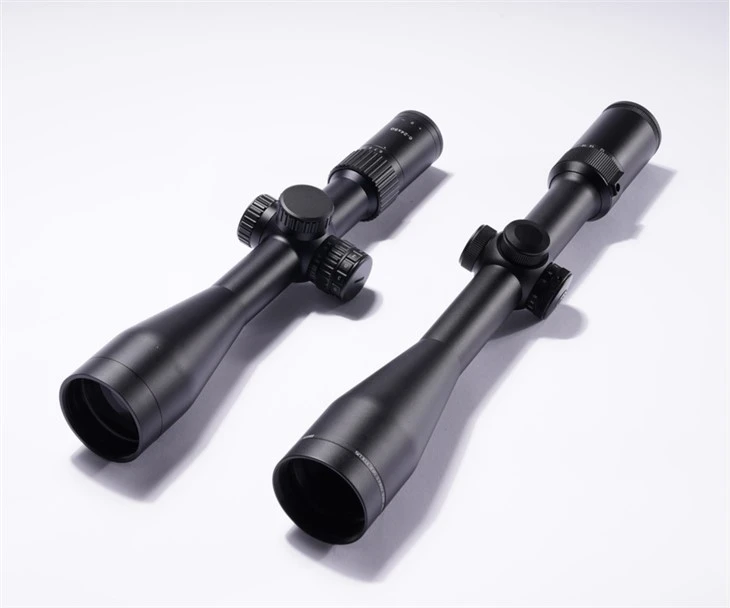
At our company, we offer a wide range of high - quality tactical rifle scopes that are designed to meet the needs of different shooters. Our Optic Sights Tactical Rifle Scopes are known for their excellent optical clarity and durability. They are equipped with advanced features such as multi - coated lenses, which reduce glare and improve light transmission, ensuring clear images even in low - light conditions.
Our Tactical Rifle Scopes with Illumiated Reticle are ideal for shooting in low - light environments. The illuminated reticle provides better visibility, allowing you to aim accurately even in the dark. The brightness of the reticle can usually be adjusted to suit different lighting conditions.
For those who require a wide field of view, our Extremely Wide Angle FFP SFP Tactical Rifle Scopes are the perfect choice. These scopes offer a wide angle of view, which is beneficial for quick target acquisition and tracking. They are available in both first - focal - plane (FFP) and second - focal - plane (SFP) configurations, depending on your specific needs.
Conclusion
In conclusion, zeroing your tactical rifle scope is an essential step that should not be overlooked. It is crucial for accuracy, confidence, and consistency in shooting. By understanding the factors that affect zeroing and following the proper zeroing procedure, you can ensure that your scope is accurately calibrated for your rifle and shooting conditions.
If you are in the market for a high - quality tactical rifle scope, we invite you to explore our product range. Our scopes are designed and manufactured to the highest standards, and we are confident that they will meet your expectations. Whether you are a hunter, a sport shooter, or a tactical operator, we have the right scope for you. Contact us today to discuss your specific requirements and start the procurement process.
References
- "The Complete Guide to Rifle Scopes" by John Smith
- "Advanced Shooting Techniques" by Mark Johnson
- "Ballistics for Beginners" by David Brown


